The Floor Beneath Her Feet
Let's call her Wanjiru. She's six, and she stands in for every child in one classroom at Thika Road Comprehensive School who, until February 2026, did their counting lessons sitting on a dirt floor.
It wasn't because nobody cared. Her teachers cared enormously. They just didn't have much to work with: broken desks, bare walls, and a room that on a good day gave a child somewhere to sit, but not yet a reason to want to stay.
Then the Rotary Club of Nairobi Thika Road walked in with paint, timber and a plan.
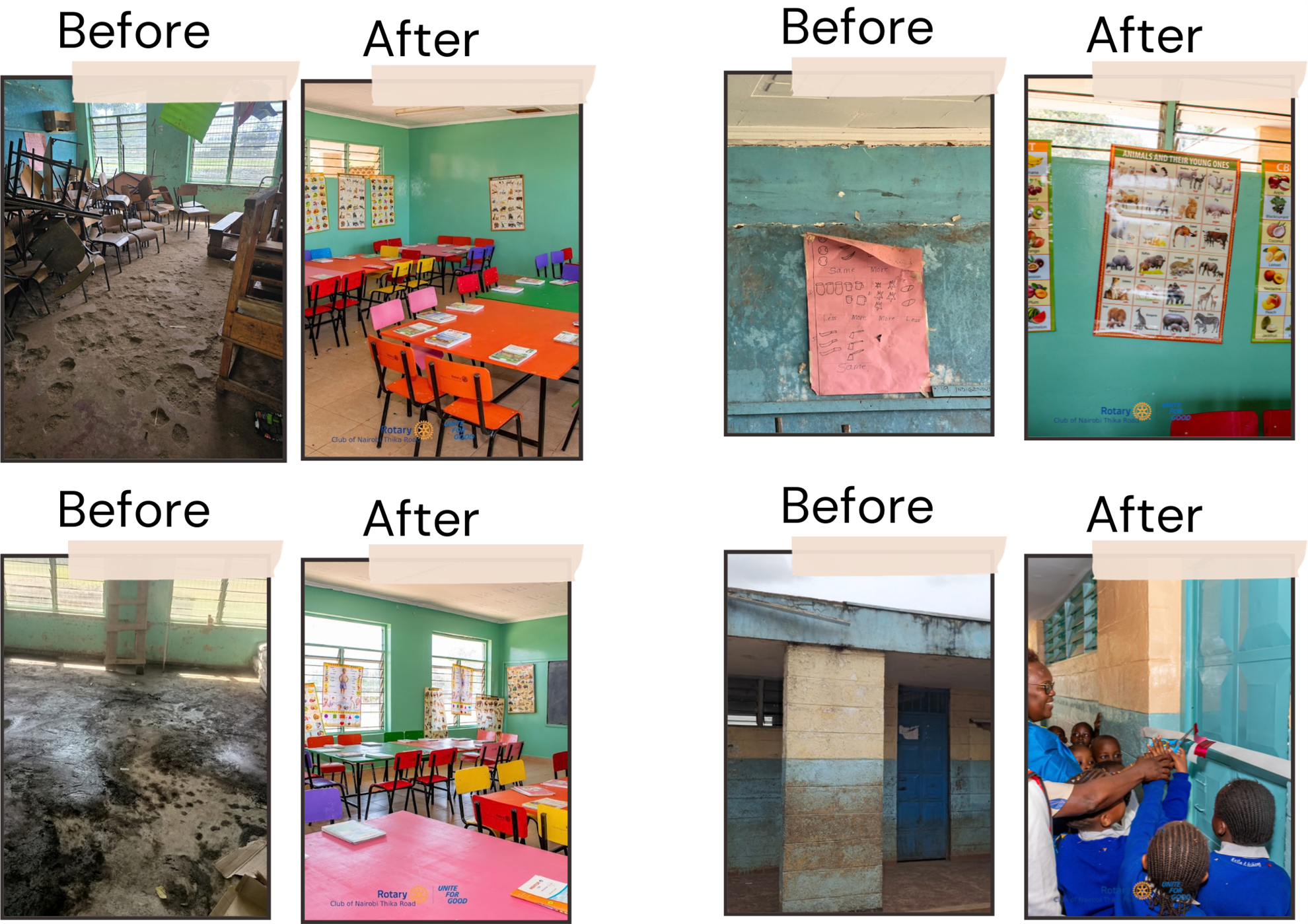
Out went the dirt floors. In came walls painted in colors bright enough to make a six-year-old stop mid-sentence and stare. The broken furniture was hauled away and replaced with desks sized for small bodies, and the shelves filled up with storybooks and learning charts that had never existed in that classroom before. On paper, it was a renovation. In practice, it was a message to every child walking back in: you are worth this.
To date, two ECD classrooms and one additional class have been fully renovated. And this is just the beginning.
But the paint was never the point. The point is whether a child wants to come back tomorrow. It's whether a parent looks at a rainy morning (and we all know what a rainy morning does to good intentions) and decides the classroom is dry and warm enough to be worth the walk.
A floor is a small thing, until it's the thing standing between a child and her education.
And a floor is only where the story starts. Once a child has somewhere dignified to sit, the next question is: who will teach her, and with what?
The Teacher Who Learned to Log In
Now travel far north, to Turkana, and meet a teacher we'll call Grace. She has spent her career teaching the way she always has: chalk, chalkboard, and a very good memory. Then Kenya's Competency-Based Curriculum (CBC) arrived and asked for something harder than delivering facts. It asked teachers to teach children how to think. And nobody had shown Grace, or many teachers like her, how to bring a digital tool into that work.
This is the quieter half of the Rotary Club of Nairobi Thika Road's story. It's not the classroom you can admire for its fresh paint, but the teacher standing at the front of it, doing her best to keep up.
The Elimika Global Grant was built to close that gap. It began as a COVID-era education project with the Global Partnership for Education. When that agreement ended in 2023, the district reorganized the grant, and the Rotary Club of Nairobi Thika Road took a leading role in reimagining it as the program it is today: digital literacy, science laboratories and teacher training, in partnership with Kenya's Ministry of Education.
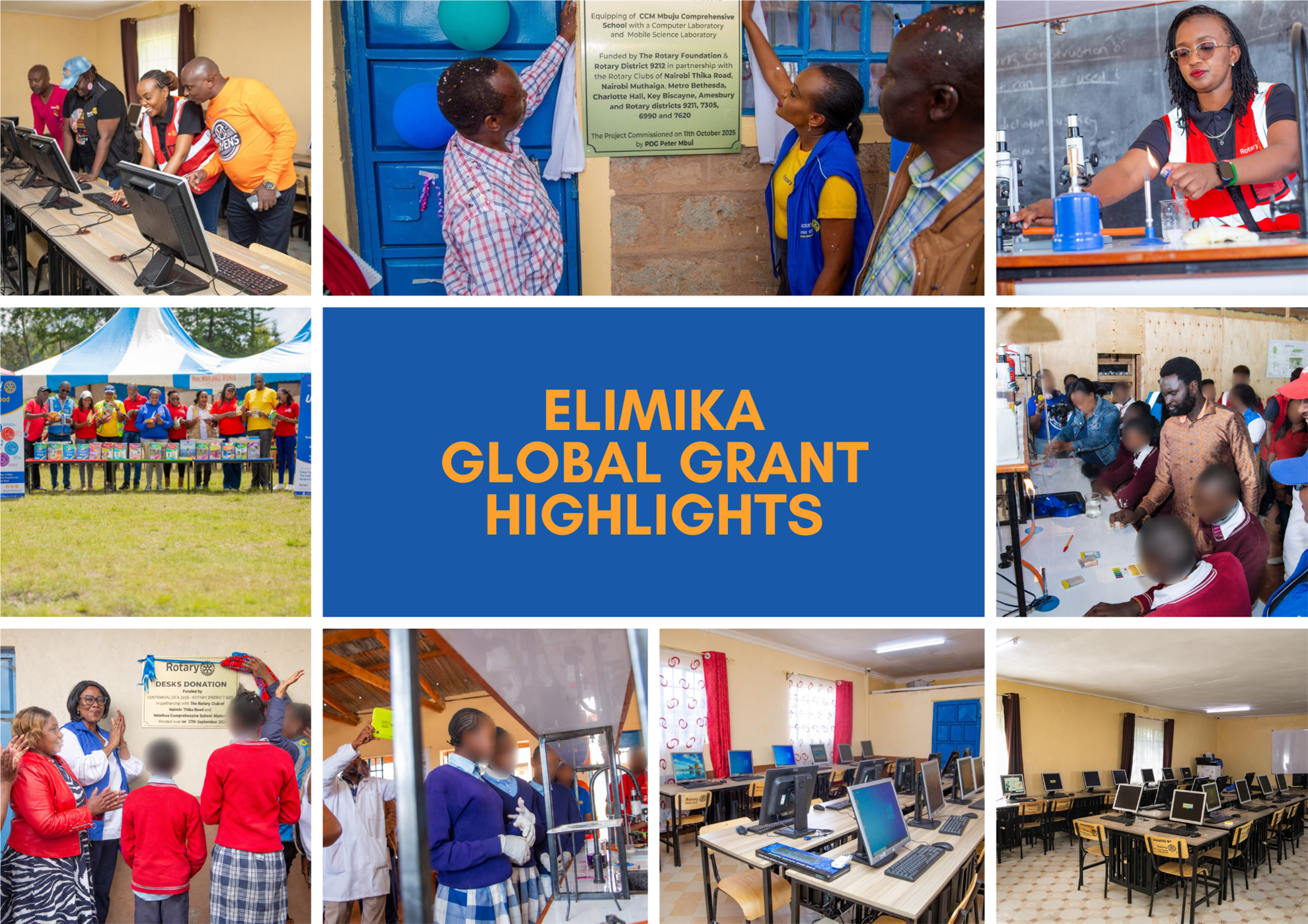
In practice, that meant a 30-computer lab in each of four schools: St. Vincent Maragi in Murang'a, CCM Mbuju Comprehensive School in Meru, Ndothua Comprehensive School in Nyandarua, and St. Monica Birisha Comprehensive School in Nyeri. Each lab comes with backup power, fire alarms, CCTV and biometric access. Each also came with a year of internet. At CCM Mbuju and Ndothua, science laboratories and kits mean experiments are something children do, not just something they copy from the board.
But the machines were only half the story. Training began with an assessment of where each teacher was starting from, and the four-day program that followed was built around the answers, not around one lesson for everyone. Its modules were developed with the Kenya Institute of Curriculum Development (KICD), so what teachers learned matched what the curriculum actually asks of them. In all, 103 teachers were trained: 63 across the four schools and 40 in Turkana Central, chosen in consultation with the County Education Director.
Here is the real arithmetic of teacher training: it is never really about one teacher. Train Grace, and you don't just change her Tuesday morning. You change every child who sits in her classroom for the rest of her career. The club estimates the reach at around 7,700 learners: roughly 1,700 in the four equipped schools and an estimated 6,000 across the wider school community in Turkana.
What the Floor Taught Us
The club is honest about one thing: it's too early to say what all of this has changed. Comprehensive monitoring and evaluation data hasn't been collected yet, so there are no big results to announce, only the right questions. How much have teachers' digital skills grown? How often are the labs really being used? And can it all be sustained once that first year of internet runs out?
What the club does know is a lesson every Rotary club should hear. Not every school was ready. Some had the rooms, the reliable power and the security for a computer lab. Others didn't. In Turkana, the two schools the club assessed, Faith Homes Comprehensive Primary School and Namadak (Kalimapus) Primary School, need classroom renovations and solar power upgrades before labs can safely go in. Rather than delay everything until every school was ready, the club equipped the four that were, and earmarked those two for the next phase.
The lesson: assess before you install. A computer is only a gift when there's a dry room to keep it in, power to run it, and a teacher who knows how to use it. Anyone who has ever bought a fancy gadget with no charger in the box understands this perfectly.
It is the lesson of that classroom at Thika Road Comprehensive School all over again. First the floor. Then the future.
The Next Classrooms Are Waiting
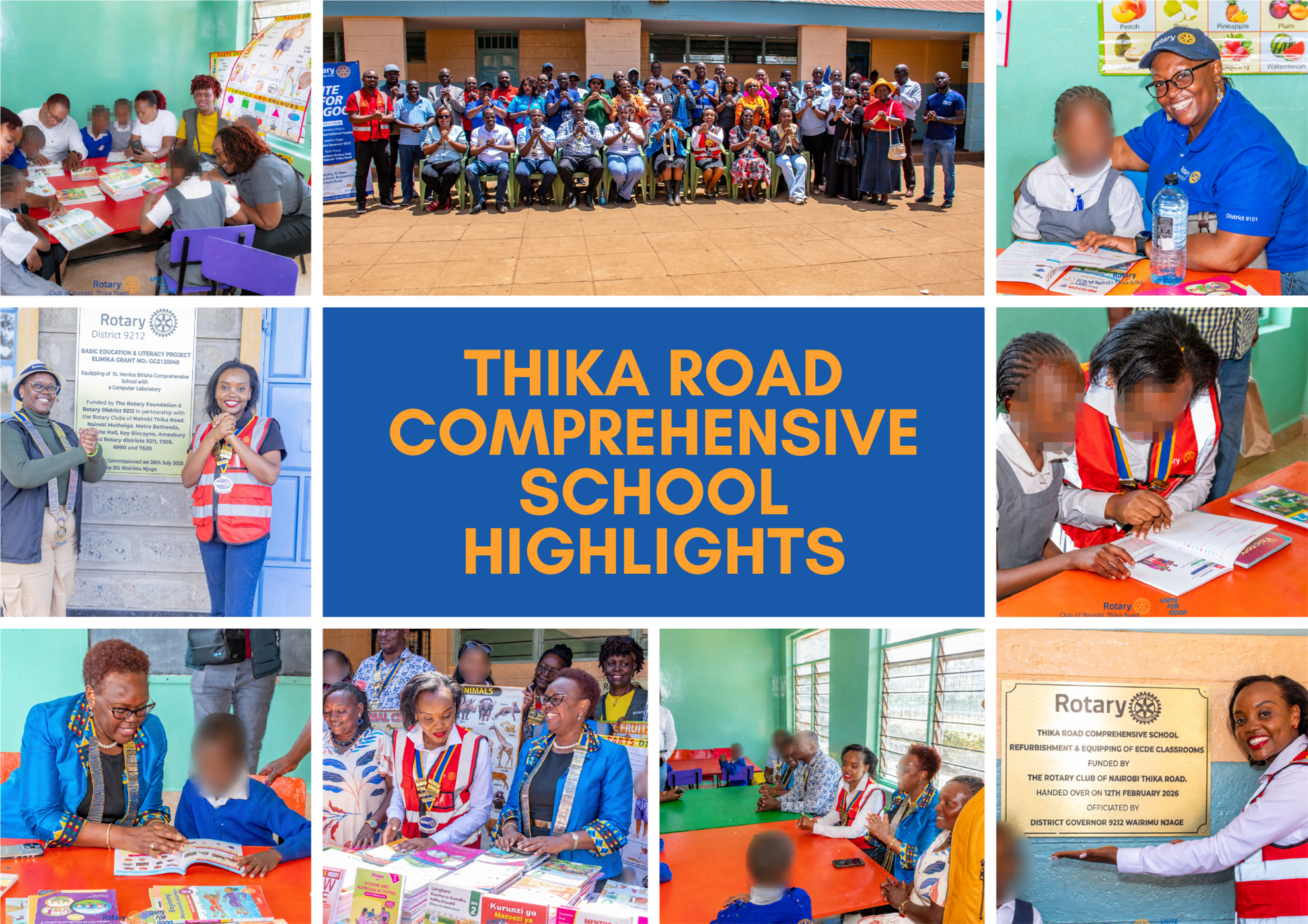
There's a version of this story that stays a status update: 3 ECD classes renovated, four labs equipped, 103 teachers trained, numbers in a report. But strip away the report and here is what's left. A child with somewhere dignified to sit and learn her letters. A teacher in Turkana who doesn't have to face a curriculum reform alone. And a club of Rotarians who heard "someone should fix this" and decided that someone meant us.
District 9216 asked every club this September to turn learning into lasting impact. The Rotary Club of Nairobi Thika Road didn't wait for September. It has been doing it one classroom, one teacher and one child at a time.
None of this happened alone. To every Rotarian, partner, donor, school and friend who has given time, money, expertise or encouragement to this work: thank you. We can't name you all, but every learner in a brighter classroom and every teacher with a new skill has you to thank.
And it isn’t finished. Back at Thika Road Comprehensive, the freshly painted classroom is only the beginning. The school still needs more classrooms renovated, a proper kitchen, a new ablution block, and dormitories. This matters because the school is home, not just a place to study, for children who might otherwise be out on the streets. For them, it is a safe bed at night, a hot meal, and a door that stays open. A school this many children lean on deserves walls, plumbing and a kitchen that can keep up with them.
In Turkana, the need is not for paint or computers but for teachers who feel confident with the new curriculum, and the 40 teachers trained so far are only a start. Every teacher who learns to bring digital tools into the classroom carries that learning to children for years to come. That takes trainers and mentors, and people who care enough to pick up the phone.
So here is the invitation, plainly. There are two places where your help would go a long way.
At Thika Road Comprehensive School, where the school is home to a population of 2000+ students, some of whom might otherwise be on the streets:
- Give toward more classroom renovations, a school kitchen, an ablution block and dormitories.
- Lend your skills: building, plumbing or carpentry.
In Turkana, to keep teachers learning:
- Give toward further teacher training.
- Lend your skills: training, mentoring, or monitoring and evaluation to help us measure what the training is changing.
Start with one email or phone call to the Rotary Club of Nairobi Thika Road: email rcnairobithikard@gmail.com, call +254 722 678 619, and visit https://rcnairobithikaroad.org/
The next classrooms that need transforming are waiting for someone to walk in with paint, power and a plan.
That someone could be you.