Think about it: from the moment you join as a member, the learning begins, the Rotary 101, the Four-Way Test, the Objects of Rotary, the fellowship, the ethos of the motto: Service Above Self, not to mention all the courses on the Rotary Learning Centre. That's your undergraduate degree.
When you step up as a committee chair or director, the curriculum deepens you’re managing programmes, driving projects, reporting upwards. That's your master’s level.
When you step up as a committee chair or director, the curriculum deepens you’re managing programmes, driving projects, reporting upwards. That's your master’s level.
Then there is the presidency. If the club membership is your undergraduate and the board role is your Master's, then the presidency is your PhD, and nobody gives you a syllabus.
They say Rotary is the world's biggest learning institution. I used to nod at that statement without fully understanding it. Now, after a year as club president, I understand it deeply.
Think about it: from the moment you join as a member, the learning begins, the Rotary 101, the Four-Way Test, the Object of Rotary, the fellowship, the ethos of the motto: Service Above Self, not to mention all the courses on the Rotary Learning Centre. That's your undergraduate degree.
When you step up as a committee chair or director, the curriculum deepens you’re managing programmes, driving projects, reporting upwards. That's your master’s level.
When you step up as a committee chair or director, the curriculum deepens you’re managing programmes, driving projects, reporting upwards. That's your master’s level.
Then there is the presidency. If the club membership is your undergraduate and the board role is your Master's, then the presidency is your PhD, and nobody gives you a syllabus.
What They Don't Teach You
The coursework for this PhD isn't found in any My Rotary module, as excellent as those are. It is learned in the uncomfortable silences of a committee meeting, in the follow-up messages that go unanswered for weeks, in the budget and project discussions that somehow become personal.
The hardest thing about leading a Rotary club is this: you cannot force anyone to do anything. These are volunteers, accomplished, busy, opinionated people who give their time by choice. Your only currency is persuasion, inspiration, and relationship. You cannot threaten. You cannot sanction. You lead by earning, every single week.
Managing volunteers means learning to hold people accountable without making them feel punished for being generous enough to show up at all.
And then there are the dues. The reports. The deadlines that the District sets and they have no mercy even when your club is navigating its own internal weather. Projects don't happen on their own; they require someone to carry the idea past the enthusiasm of the first meeting, through the bureaucracy of approvals, the logistics of execution, and the documentation of outcomes. That someone is you.
The Human Complexity
I also learned something about egos, including, at times, my own. In any voluntary organization, opposition comes with the territory. Some members oppose decisions because they have genuine concerns. Others oppose simply because they can, because there is no hierarchy powerful enough to silence them, and dissent is how they assert their presence. The job is not to win every argument, but to keep the fellowship intact while still moving forward. That is a balancing act that no training fully prepares you for. You develop the skill by doing it, imperfectly, repeatedly, until something resembling wisdom begins to emerge.
When Life Happens
Here is something no one says out loud often enough: sometimes, life happens, and even your board members go MIA.
People have jobs, families, health challenges, personal crises. The same is true of the club president, but the difference is that the club cannot wait. Meetings must happen. Reports must be submitted. District deadlines do not move because your treasurer is unreachable or your committee chair has gone quiet for three weeks.
WhatsApp messages sit unread. Reports trickle in late or not at all. You send a follow-up, and then another, and then you make peace with the fact that you will be writing that report yourself at eleven o'clock on a Thursday night.
And yet, somehow, the club runs.
Because invariably, someone steps up. Not always the person whose role it was. Sometimes it is a regular member with no formal title who simply sees the gap and fills it quietly, without fanfare, without waiting to be asked. These are the people a president learns to treasure. They are the engine that keeps things moving when the organizational chart stops reflecting reality.
This year taught me that a club's true resilience lives not in its structure, but in the handful of people who refuse to let things fall apart even when they have every excuse to let someone else worry about it. You know who you are and I am deeply grateful.
When the Ground Shifts
Midway through the year, we lost our regular meeting venue a place that had been home to our fellowship for seven years. Seven years of weekly meetings, debates, laughter, and a familiarity that you don't fully appreciate until it's gone.
Losing a venue sounds administrative. It isn't. A meeting place carries the memory and culture of a club. Losing ours created real uncertainty about where we would go and whether the momentum we had built would survive the disruption.
But then something happened that reminded me exactly why I am proud of this club.
Members did not wait to be told what to do. They stepped up. They reached out. They identified possible venues, made calls, visited locations, and refused to let the search drift into indefinite limbo. The result? We now meet in a venue that is, by every measure, much better than the one we lost. Better facilities, better atmosphere, better suited to where we are going as a club.
That outcome didn't happen because of the president. It happened because members refused to give up when something familiar was taken away. That, to me, is the true character of a club.
And then there were the moments quieter, more personal, when the weight of the year felt heavy. It was in those moments that certain members would reach out: not with action items or agenda points, but with a word of encouragement, a check-in message, a quiet reminder that the work we were doing mattered. Those gestures cost very little and meant everything.
What We Built
Despite all of this, or perhaps because of it, this has been a year I will not forget.
We gave wheelchairs and other support to more than 60 children living with cerebral palsy across Embu and Bungoma counties.
Let me sit with that for a moment, because the number alone doesn't tell the story.
Cerebral palsy is a condition that confines not just the child, but the entire family around them. Many of these children spend their days in the same corner, the same room, entirely dependent on a caregiver who cannot leave them, cannot rest, cannot pursue a livelihood without first solving the impossible equation of who will watch over their child. The caregiver, most often a mother, quietly disappears into that role, year after year, with very little acknowledgement and even less relief.
A wheelchair changes that equation.
Suddenly, a child who could not move can be taken outside. Can feel the sun. Can be brought to school, to church, to the market, to life. The world that was previously a ceiling becomes a horizon. And the caregiver, for the first time in perhaps years, has hands that are at least partially free to work, to rest, to tend to their other children, to simply breathe.
These are children who are too often forgotten, tucked away not out of malice but out of the exhaustion that comes with caring for them without any support. Society moves around them and rarely stops to ask what they need. We stopped. We asked. And then we showed up with something practical, something that will change the texture of daily life for sixty families in ways that no report or photograph can fully capture.
Sixty children. Sixty families. Sixty small worlds that opened up a little wider because our club chose to act. That is what Service Above Self looks like when it leaves the fellowship room and lands in the real world.
A Stage for the Forgotten
And then there was the beauty pageant.
For the first time in our club's history and perhaps the first time in the district, we organized a beauty pageant that brought together male and female inmates as well as prison guards from three prisons in Murang'a County. Three institutions. A community of people who society had largely written off or rendered invisible. We gave them a stage, a spotlight, and an audience that came to celebrate them.
I am still processing what that day meant. What I know is that it reminded me why Rotary exists: behind every project is a human being waiting to be seen, waiting to be valued, waiting to be reminded that the world has not forgotten them.
With Gratitude
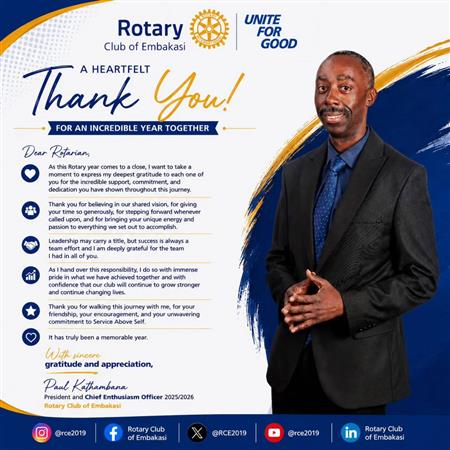
A year like this is never carried alone, and I want to say thank you.
To my club members for your service, your resilience, your patience with me, and your refusal to give up even when things were hard. To those who stepped into the gaps without being asked, who sent the encouraging message at the right moment, who showed up even when it would have been easier not to, this year belongs to you as much as it does to me.
To my colleagues at the Kenya Tourism Board led by June Chepkemei, for your understanding and flexibility on the many occasions when Rotary duties required my time and attention. Your support made it possible to serve well in both spaces.
To my family, who saw the early mornings, the late evenings, the weekends given over to meetings and projects, and who never made me feel guilty for it. Your quiet support was the foundation everything else rested on. Thank you.
The Degree I Earned
Rotary gives you one year not because the work is easy, but because one year, done well, is enough to leave a mark. The presidency is a single year by design; a baton, not a throne. You carry it, you run your leg of the race as hard as you can, and then you pass it on. In the beginning it feels both too long and not long enough. By the end, you understand why it is exactly right.
That is the beauty of Rotary. No one person is the story. The club was here before you, and it will thrive long after you hand over the gavel. The club is the story.
Leadership in voluntary organizations teaches lessons that formal management never can. There is no authority to hide behind. No hierarchy to enforce your decisions. No leverage to compel action. There is only trust, persuasion, and the relationships you have been deliberate enough to build. To everyone who serves quietly in communities around the world, I see you. Sometimes the hardest leadership roles are the ones nobody pays you for.
Rotary gave me a PhD this year. It was rigorous, unglamorous, and occasionally maddening. It was also one of the greatest privileges of my life.